
Check the scope of a programme claim
A curriculum overview may cover the whole school group. Find the page for the child’s division, campus and intended intake. Save the heading that answers the question so a colleague can reopen a long handbook at the right place.
Record the date twice when necessary
The year printed on the document tells you when its rules apply. The day you read it tells your team when someone checked. These serve different purposes when a school replaces an admissions page between a shortlist meeting and submission.
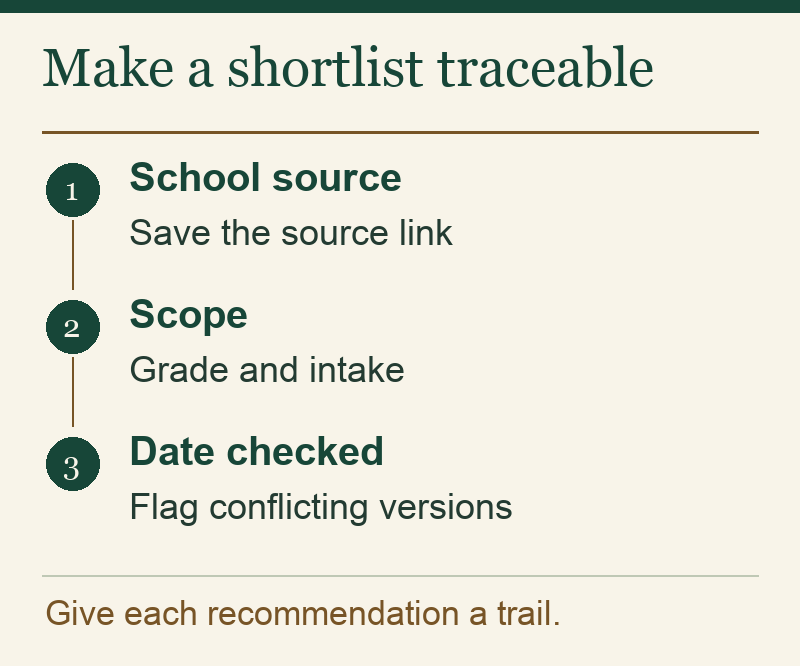
For one shortlist claim, keep five fields together: page title, section heading, campus and division, academic year covered, and date checked. The parent-facing note can then cite the relevant part without reproducing a whole brochure.
Handle conflicting information in the open
Keep both references if a brochure and a current admissions page disagree. Ask the admissions office the smallest question that would change the family’s decision. Attach its reply to the relevant intake once it arrives.
Make the shortlist usable
For each option, write one evidenced reason to keep it and one question that could remove it. A family choosing by commute needs a route confirmation; a family choosing a subject pathway needs the current course and year range.
Write the sentence the evidence needs to support
Start with the family's actual choice. “Can our child continue studying music at this campus after the move?” is a better research question than “Is this a good school for music?” It tells you which child, subject and campus to investigate, and it points towards a decision about continuity. Ask whether music means a timetabled subject, individual instrument lessons or an after-school ensemble. A school may offer all three in different parts of its organisation. Evidence of a concert does little to establish the availability of a particular class.
Write one proposed sentence in the language you would use with the parent. Underline every part that could be wrong independently. “The north campus offers strings during the school day for the student's entry year” contains a campus, an activity, a timetable and an eligible year. You may be able to verify three immediately. If you cannot verify the fourth, narrow the sentence to the three you can support and write a question about the fourth. Avoid dropping the missing part if it is precisely what the family needs to decide.
Follow the source beyond the search result
Open the document itself and locate the heading that contains the relevant statement. Look above the heading for the division and below it for conditions. A prominent school group page may describe courses available somewhere in the group. A campus handbook can narrow the offering to specific years, and a subject selection booklet can add prerequisites or a minimum enrolment. Keep the sources that bear on the family question; a large collection of loosely connected links makes it harder to see which statement actually carries the recommendation.
Read enough surrounding text to understand verbs. “Students may apply for” describes an opportunity to seek a place. “All students take” describes a compulsory subject. “Plans to introduce” describes an intention. Write those distinctions into your own sentence. If a parent is choosing a campus because a child wants to join an orchestra, the fact that auditions take place is useful even if nobody can confirm admission to the group. Present it as an audition opportunity and explain what the family would need to find out next.
Keep a compact locator for a lengthy document. Note its title as displayed, the academic year, printed page number when there is one, and the heading. A PDF viewer may count the cover as page one while the printed page numbers start later. The heading still gets a colleague to the right place. When a document is revised in place, retaining the version or an appropriately stored working copy can help explain why an earlier family summary used different wording.
Compare sources that answer different questions
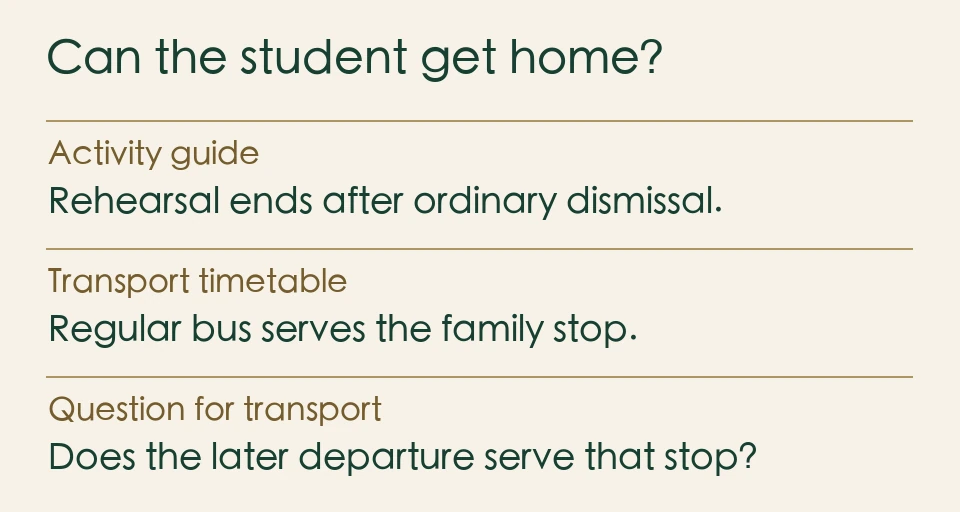
Suppose the family needs a bus after the music rehearsal. The school's transport page may establish that the area is served before and after normal lessons. The activity page may establish that rehearsal finishes late. Neither source alone tells you whether a bus departs after the rehearsal. Preserve both statements, then send one question about the remaining connection: “For the proposed intake and this campus, is there a departure after the listed rehearsal on that day, and does it serve the named stop?”
Use the same approach for a subject that appears in a fee schedule. A charge for laboratory materials tells you the school charges some students for those materials. It does not identify the campuses offering the subject or establish room in a particular class. Keep the cost question in the fee comparison until the programme question is resolved. The family should be able to see why one row is priced while another still needs an admissions response.
A visit can add a valuable observation without establishing a future promise. Record the date, who attended and what the family actually saw. “The student visited the workshop on Tuesday” is a sound observation. “The student will have workshop access every day” requires a timetable and the rules for that year group. Ask the person leading the visit which written material describes access for an incoming student, or whom to contact for a written answer.
Ask the smallest question that could change the shortlist
When two school sources disagree, check their scope before calling it a conflict. A junior campus timetable and a senior campus activities guide can both be correct. If both really concern the same intake and division, quote just the disputed point and name both documents. “The campus programme lists this course in Year Nine, while the new subject guide lists it from Year Ten. For a Year Nine student entering North Campus in August, which applies?” The school can answer without conducting a general review of your research.
Record the date and scope of the reply and distinguish a decision from a referral. Admissions may say that a department head will confirm classes after subject choices close. That locates the right decision maker and the trigger for another check; it does not establish a class. Give the family a date to hear from you even if the department has yet to settle its timetable. A conditional option can remain on the list as long as the condition is visible and worth pursuing.
Fictional example: the course existed but the journey did not work
The fictional Vale family wants a school where their child can continue playing a string instrument and return home by school transport. The parent initially favours fictional Orchard Quay because its group website shows an orchestra. At fictional Sedge Lane the parent sees no concert photographs and assumes it has fewer opportunities. The adviser asks two questions before ranking either option: what musical activity is actually available to this entry year, and how would the child get home on that day?
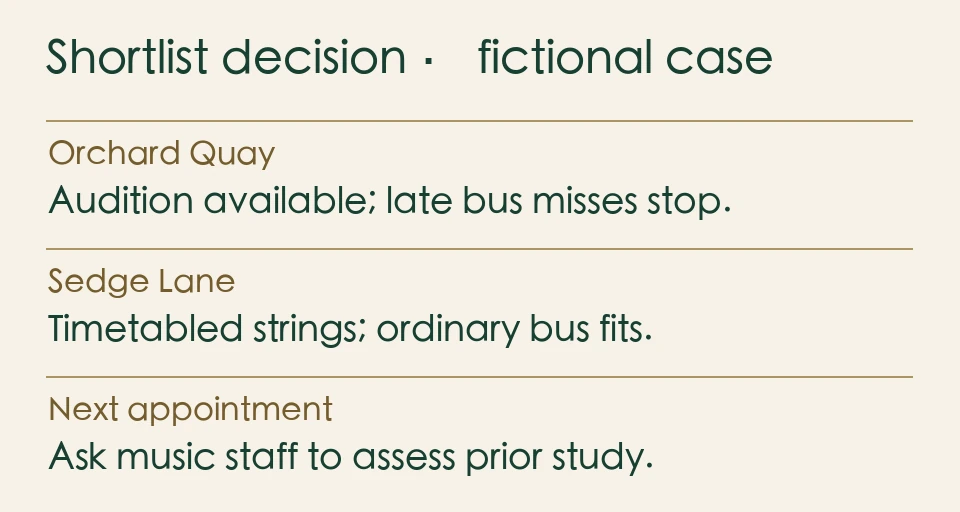
Orchard Quay's campus handbook lists an auditioned ensemble open to the child's year. Its transport schedule lists an afternoon departure to the family's stop, while the rehearsal notice gives a later finish. The adviser records the three headings separately and asks transport about a later departure. The office confirms that the late bus serves a different area. The family cannot arrange a weekly collection, so Orchard Quay comes off the active visit list for this move. The reason is the journey after rehearsal, not the quality of the music programme.
Sedge Lane's subject list describes a timetabled string class for the relevant campus and year. Its subject guide also says joining students must discuss prior study with the music department. The ordinary afternoon bus serves the family's stop. The adviser asks the department whether the child can have that discussion before a visit and what material to bring. The department offers an appointment. The family books it knowing that eligibility to be considered is established and a place in the class is still open.
The parent-facing note reads: “Sedge Lane merits a visit because strings are timetabled in the relevant year and the ordinary bus fits the journey. The department will discuss prior study at the appointment. Orchard Quay has an eligible ensemble, but the confirmed late route does not reach your stop.” Both judgements can be reopened if the family moves house or the school publishes a new timetable. Neither depends on which school displayed the more impressive photograph.
Hand over a shortlist that can be corrected
Give the parent a short reason, its source and the remaining decision for each school. Invite them to mark any assumption about the family that has changed. If the child's priority shifts from ensemble playing to individual lessons, revisit the activity evidence before changing the ranking. A source can remain perfectly accurate while losing its relevance to the family. The family intake note is the place to reconcile that change before rearranging visits.
Before presentation, ask a colleague to reopen one difficult claim using only your locator. Can they identify the same campus, find the passage and tell which word limits its meaning? If two different readings are plausible, revise the sentence or ask the school. Finally, name the event that would make you check again: publication of next year's booklet, the department confirming numbers, a change of stop or the family choosing a different entry term. The parent then knows which parts of the recommendation can be acted on today and which will need another look.