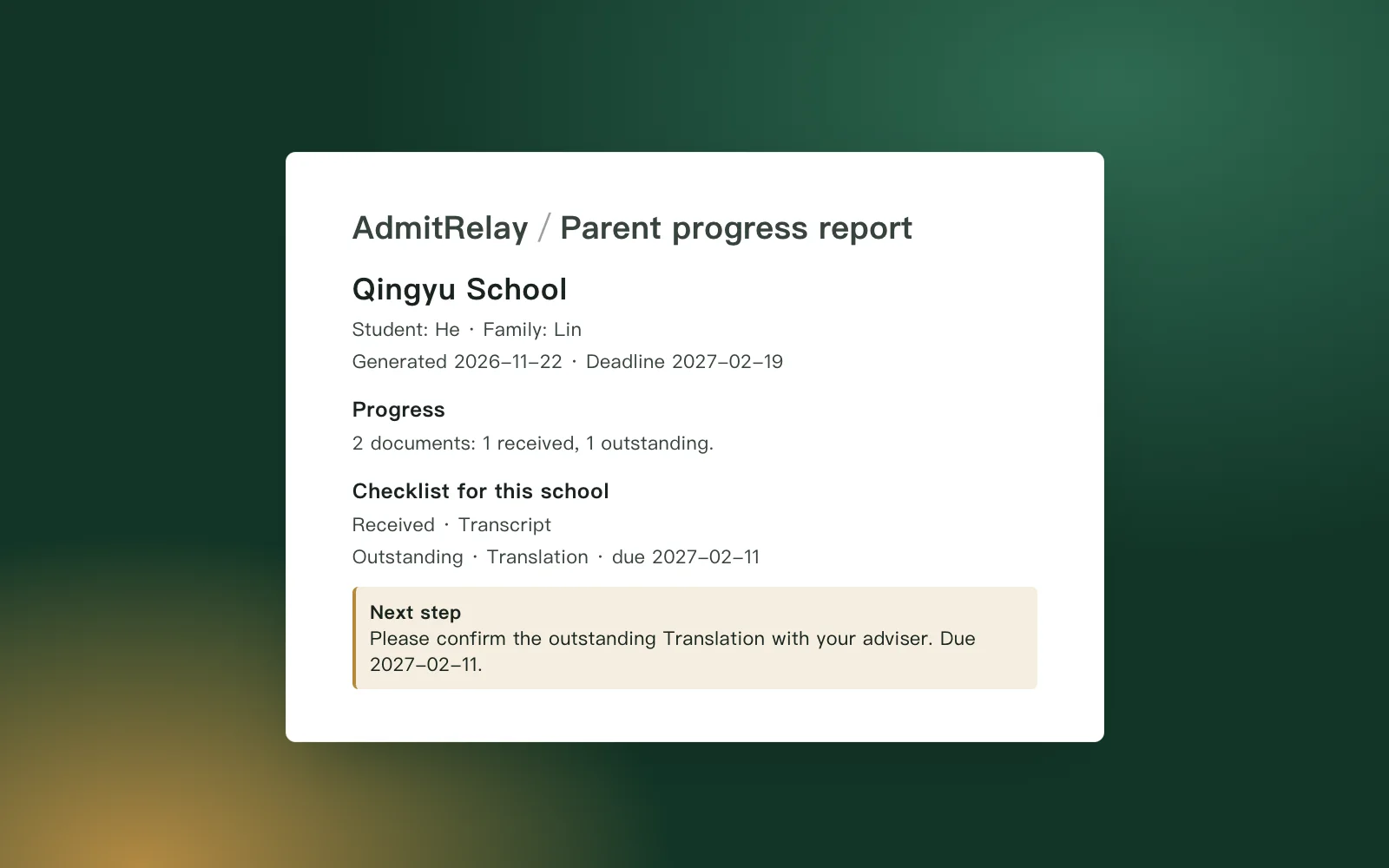
Describe what the school actually confirmed
“Admissions acknowledged the spring transcript on Monday” is easier to act on than “documents in progress”. If there has been no change, include when you last checked and the follow-up you have scheduled.
Turn a missing item into a request
Name the form, page, signer and return route. A parent who hears “signature missing” may resend the whole file. A request for the guardian signature on the school’s consent page tells them exactly what to repair.
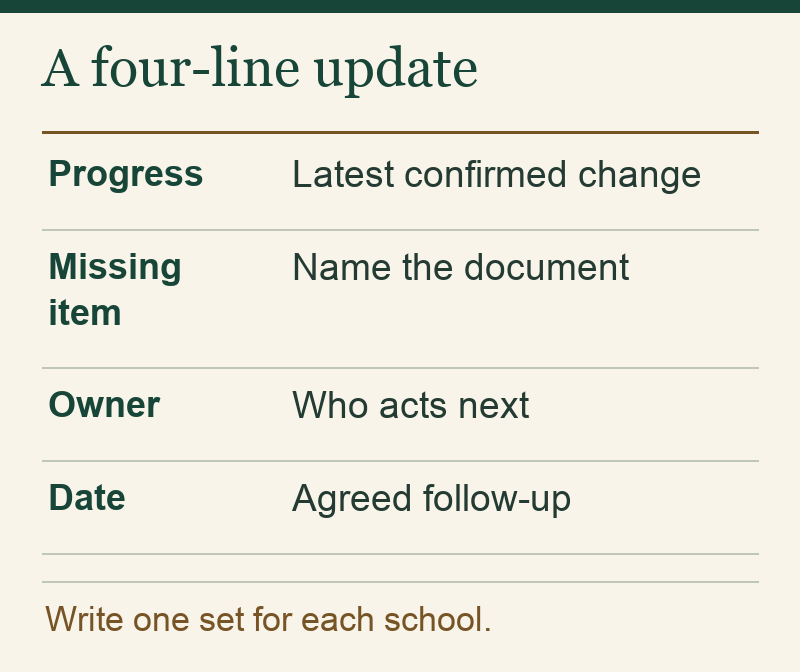
Give each school its own line
For the fictional Bay Orchard and Stone Creek schools, one update might read:
Bay Orchard has the report; I will trace the teacher reference on Wednesday. Stone Creek has offered an interview; please confirm which guardian can attend by Tuesday.
Close with the date the family will hear from you again.
Leave attachments out of routine updates
A progress message normally needs the document name and its state. Exchange identity documents and school reports through the agreed route. Keep confidential teacher correspondence with its designated recipients.
Begin with the last promise you made to this family
Open the previous update and read the last line before looking at new messages. What did you say you would check, and when did you promise to report back? If you told a parent you would check a reference on Wednesday, Thursday's update should say what that check established even if the school has sent no new decision. Starting from your earlier promise makes the update feel continuous and prevents an old unanswered question disappearing beneath a more exciting new invitation.
Next, look at each active application and identify one change since the last family message. A change can be a document received, an invitation corrected, a cost clarified or a family decision that alters the shortlist. Write down the evidence and the time first. Then decide whether the family needs that detail or just its practical consequence. A long internal record of calls can often become one short sentence: “The office has confirmed it can accept the June report, so you can keep the original appointment.”
If two messages conflict, resolve the part you can before sending. A parent may have forwarded an old reminder after admissions acknowledged the missing item. Compare the timestamps of the underlying messages. If the acknowledgement definitely covers the same document and student, explain why the older reminder can be set aside. If they concern different pages, state exactly which page is still needed. Avoid making a family decide between two pieces of correspondence that the adviser can already interpret.
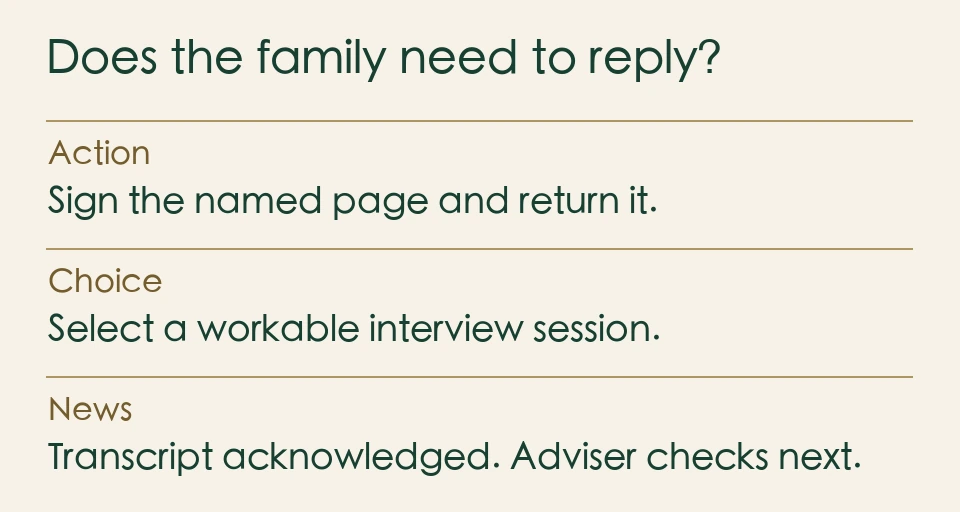
Decide whether the parent has an action, a choice or simply news
An action can be completed with enough instruction. “Sign the guardian declaration on page two and return it through the school's named channel by Thursday” gives the parent an object, a place and a time. A choice needs options and a consequence. “Tuesday's interview is at the nearer campus; Friday's session requires travel to the other site. Which can the accompanying adult attend?” A piece of news needs neither a new request nor a reply. Tell the family when no action is required so they can stop searching the message for an implied task.
Place the most time-sensitive family decision where it will be seen on a phone. If the family has a school reply due today, lead with the decision and explain the background in the following sentence. If the decision belongs to a parent who is travelling, find out who can receive updates and who is authorised to make the choice. Sending a clear message to someone unable to decide does little to meet the deadline.
Choose an appropriate amount of evidence. A parent may want the school’s wording when signing an offer or considering a non-refundable charge. In that case point them to the specific letter and passage, and ask them to read it before deciding. For a routine status change, the date and nature of the acknowledgement are often enough. A parent progress report can collect the family-facing information while the school's original evidence remains available in the case.
Write a useful update when the school is silent
Silence after a promised check is still a reportable state. Explain where you checked, the most recent confirmed fact and what will trigger the next enquiry. “I checked the application this morning. Admissions still lists the reference as pending. The teacher confirmed sending it on Tuesday, so I have asked the office to match it. I will update you on Friday even if it is still checking.” This explains the next action without making the teacher the target of another family reminder.
If the school has given an estimated decision period, retain the qualification. An estimate can help the family plan a follow-up but is different from a promise of an offer by a certain day. If the estimated period passes, write what you have done to obtain clarification and check whether another school has an independent reply date. A family holding an offer elsewhere may have a decision to take before the silent school responds. Flag that choice in its own line and keep each school's commitments separate.
Be specific about uncertainty that changes what the family should do. “We know a report arrived but cannot yet confirm which term the office matched” calls for a trace. “The office has confirmed the report but has yet to review the application” calls for patience and an agreed check date. Describing both as “still processing” gives the parent no way to tell whether to obtain another report, call the teacher or simply wait.
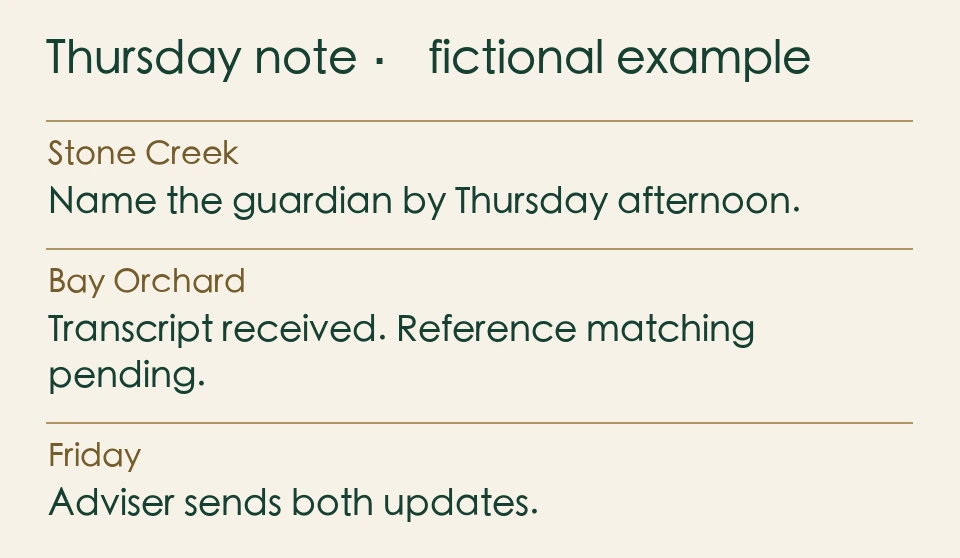
Fictional example: a Thursday update built from Monday's note
At fictional Bay Orchard the family expects confirmation that a spring transcript and a teacher reference have been matched. At fictional Stone Creek the student has an interview invitation that requires a guardian. On Monday the adviser promised to check Bay Orchard on Wednesday and tell the family which adult could attend Stone Creek. The internal record contains a transcript receipt, the teacher's dispatch date and two emails about the interview, one older than the other.
On Wednesday Bay Orchard confirms the spring transcript but says the teacher reference is still being matched. The teacher has already submitted through the required channel. Stone Creek's newer message confirms that either guardian may attend but asks for the attendee's name by Thursday afternoon. The adviser compares both school messages with Monday's promises. One family decision is urgent; one piece of matching work belongs to admissions.
The message reads: “Stone Creek needs the attending guardian's name by Thursday afternoon. Either guardian may attend. Please tell me who will go so I can reply in the invitation thread. Bay Orchard confirmed the spring transcript on Wednesday. Your teacher has submitted the reference, and I am checking its matching with admissions. You can leave that part with me. I will send you the interview confirmation and another Bay Orchard update on Friday.”
The parent replies with a guardian name and asks whether both applications are complete. The adviser confirms the name with Stone Creek and replies: “Stone Creek now has the attendee's name for the interview. At Bay Orchard the report is on file and one match is outstanding. Neither school has sent an admissions decision.” On Friday Bay Orchard confirms the match. The adviser honours the promised update, identifies the new evidence and tells the family when to expect the next scheduled check.
Repair a message that has already caused confusion
If a parent interprets “submitted” as “accepted”, correct the specific misunderstanding promptly. “When I wrote submitted, I meant the school has acknowledged the application form. Its admissions decision is still outstanding. No deposit or acceptance action has been requested.” If you used an ambiguous term yourself, replace it in the next written update and keep the school's actual wording beside the record. The purpose is to give the family a stable reading of the case, not to win an argument about terminology.
When a family has acted on an outdated message, establish what actually happened before sending further instructions. A parent might have uploaded another copy of the same report or replied directly to an invitation. Retrieve the relevant acknowledgement and tell the school only what it needs to reconcile the records. Then send one revised family message that states which earlier instruction has been superseded, which action has already been completed and who now owns the next step.
Run a phone-screen reading test
Read the first two lines on their own. Can the parent identify the school and tell whether they must act? Read the final line separately. Does it give a realistic time when the family will hear from the adviser even if admissions has not replied? Then check every verb against the evidence. If you wrote confirmed, ask who confirmed exactly what. If you wrote waiting, identify who can end the wait. If you wrote urgent, name the actual time and consequence.
Before sending the report to the agreed recipient, confirm it contains only this family's information and only the schools discussed. Check attachments separately: a report from a previous family appointment can remain selected even when the message text is correct. For a family with two children, name the child beside each action. Close the working note with the time the update was sent, the decision you are expecting and the date you promised to follow up. That line becomes the starting point for the next update.
When parents share responsibility across time zones, add the reply deadline in the place where the decision maker will be that day. Ask which parent will send the answer. Receiving two different slot choices in separate conversations is a signal to clarify the family decision before passing either choice to admissions.