
Set the unit of comparison
Choose the same academic year and entry level. Check the currency, billing period and number of instalments. For a midyear start, ask which instalments the family would actually owe rather than multiplying a term figure by habit.
Distinguish cash due from cost incurred
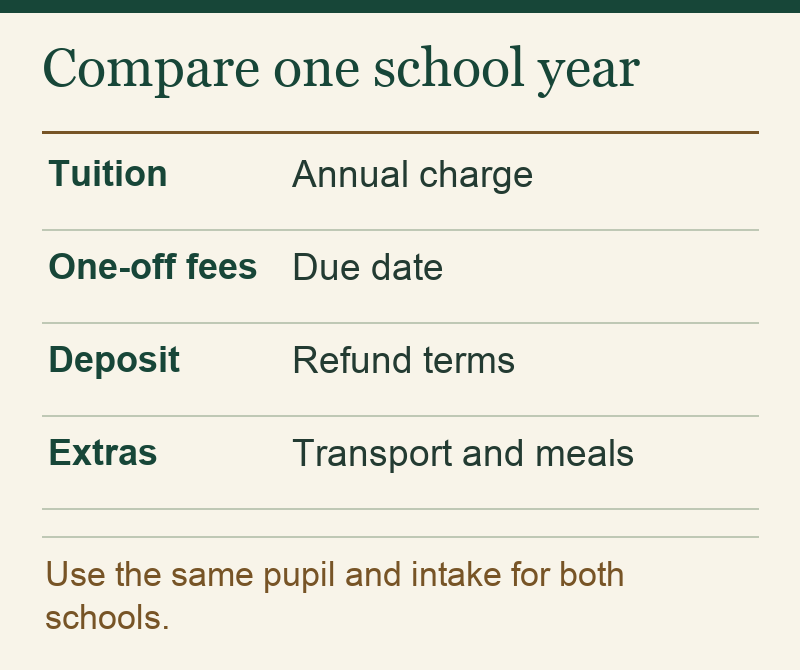
Give application charges, enrolment charges, tuition and deposits separate rows. Copy the refund conditions next to any deposit. A deposit can affect the cash needed to accept a place even if the family might later recover it.
Use two worksheet rows. Cash due on acceptance includes the tuition instalment, charges and deposit payable at that point. Known non-refundable cost across the year includes tuition, non-refundable charges and priced services the family selects. Credit an earlier payment against tuition only when the school says it will do so.
Price the services the family would use
Bus routes, meal arrangements and required equipment can change the comparison. A blank cell means the price still needs a source. Keep original currencies visible when converting totals and label the exchange rate used for the family’s estimate.
Annotate the difference
Give the family a short explanation such as “The tuition periods match. The larger initial payment includes an enrolment charge; transport will depend on your route.” Save the published schedule and date checked beside the figures.
Ask which bill the family is trying to understand
A parent who asks “Which is cheaper?” may be trying to decide whether there is enough cash to accept an offer next Friday. Another parent may be comparing annual costs for an employer allowance. A third wants to know what happens to the money if the move falls through. Write the question above the figures. For a decision on Friday, calculate the amount still to transfer by that date. For an annual comparison, show tuition and the compulsory charges that apply to this child. For a possible withdrawal, obtain the terms applicable to this intake before saying what could be recovered.
Use one column per school and reserve the first rows for campus, entry year, start date and currency. Keep the school's own fee labels in the working copy. A parent-facing translation is useful, but two charges both translated as “registration” might be due at quite different points. Record the original heading and a short description of what triggers payment. This gives the next adviser a way to answer a question without reconstructing your interpretation from a single total.
Follow one charge from the schedule to its due date
Read the full fee schedule alongside the offer letter or admissions instructions for the proposed intake. Start at the first payment a new family would encounter. Is there a fee to have an application considered? Does a separate charge arise only when a place is offered? What must be paid to accept, and when does the first tuition invoice fall due? Write each answer on its own row with the source heading or page. If a schedule applies to returning students, look for the separate information supplied to new families.
A school may publish a full-year tuition rate and then show its instalment dates below. Adding the full tuition and every instalment would charge the family twice. Reconcile the sum of instalments with the amount shown for the year. If they differ, ask whether the family is looking at an instalment premium, a separate service or a rate for a different entry group. Keep the unexplained difference open until someone authorised to explain the schedule has answered.
Read the terms for any amount described as a deposit or reservation payment. It might be held until the student leaves, applied to a particular tuition invoice or subject to a separate condition. Find the words that explain how that exact payment is treated. Enter the outgoing cash on its payment date. If the amount will be credited against tuition, enter the credit at the invoice it offsets. If the school describes a possible refund after withdrawal, record the condition separately. Treating either one as cash in the family's account today can leave them short at acceptance.
Work an example with a checkable answer
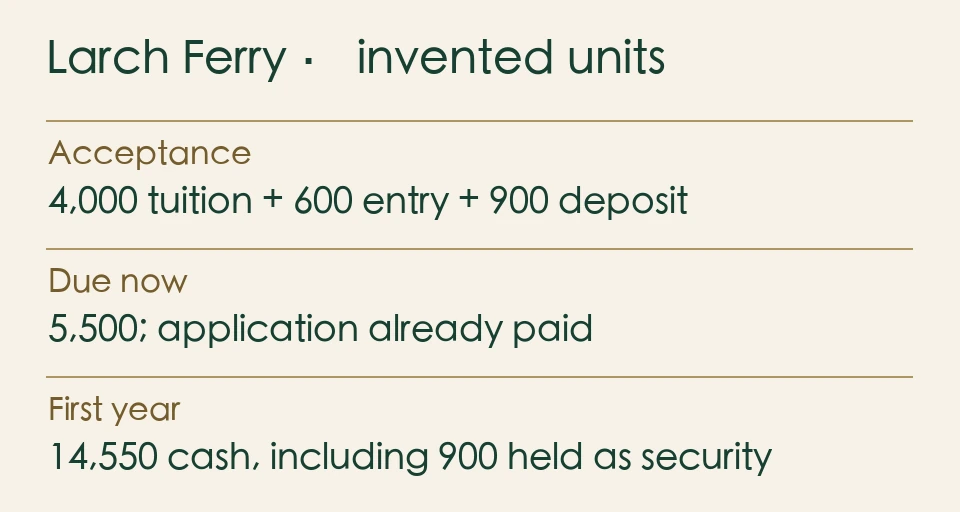
Fictional example using invented currency units and invented terms. At Larch Ferry School a family has already paid 150 to apply. First-year tuition is 12,000, billed in three equal instalments. On acceptance the family owes the first 4,000 instalment, a one-time entry charge of 600 and a security deposit of 900. The schedule says the deposit is held separately and may be returned if the family meets the stated exit conditions. The family has selected a bus route priced at 300 per term, billed after each term starts.
The acceptance payment is 4,000 plus 600 plus 900, giving 5,500 still due at acceptance. The application fee has already left the family's account. The bus has its own invoice date. Across the first complete year, the cash paid is 150 plus 12,000 plus 600 plus 900 plus 900 in bus charges, or 14,550. Identify the 900 security deposit within that figure. Tuition, the application and entry charges and the chosen transport together come to 13,650. The deposit's eventual treatment remains subject to the fictional school's terms.
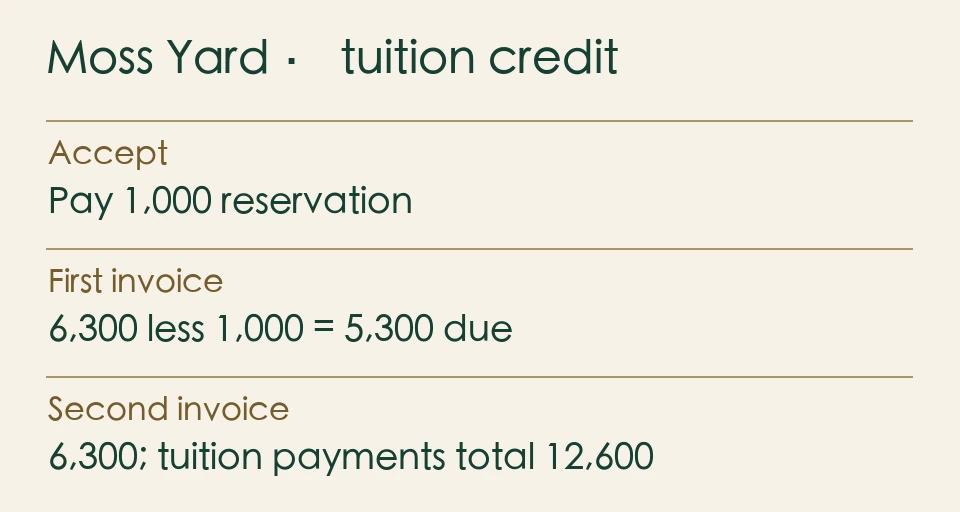
At fictional Moss Yard School tuition is 12,600 in two instalments. The family has paid 100 to apply. A 1,000 reservation payment is due on acceptance and the school explicitly credits it against the first 6,300 tuition invoice. The family then owes 5,300 on that first invoice and 6,300 on the second. Transport is 700 for the whole year and there is no separate entry charge in this example. Total first-year cash is 100 plus 1,000 plus 5,300 plus 6,300 plus 700, or 13,400.
Read the comparison back in the order the parent asked for. Moss Yard requires 1,000 at acceptance; Larch Ferry requires 5,500. Ask when the Moss Yard balance of 5,300 is due before calling that first payment easier for the family. For the full year, the difference in cash paid is 1,150. Of that difference, 900 is the Larch Ferry deposit. The difference between the other priced items is 250. A statement that one school costs 1,150 more with no explanation would hide the difference the family most needs to understand.
Recalculate when the child joins partway through the year
Set the annual comparison aside and list only the invoices the school says will apply after the proposed entry date. Ask whether the charge for the current term is full, prorated or individually quoted. Ask separately about one-time charges and the transport start date. A family entering halfway through a year might owe a full entry charge even when it receives a partial tuition invoice. Do not divide every charge by two just because half the school year has elapsed.
For an employer-funded move, ask who pays each invoice and when reimbursement occurs. The family may have to advance the tuition, wait for an invoice in the employer's required format and submit it afterwards. Keep school charges intact and place any confirmed employer contribution in a separate family planning column. If reimbursement depends on an approval the family has yet to obtain, show the amount they would have to fund without it. An employer promise cannot change the balance due to the school.
Send a targeted question about a missing or conflicting figure
Write to the office that issued the fee document. “We are preparing a first-year estimate for entry to the named campus in January. The published table gives a term tuition figure, while the offer asks for a reservation payment. Please confirm the tuition instalments for this start date, whether the reservation amount is credited, and the date of that credit. Could you identify the applicable schedule so the family can keep it with the offer?” Include the minimum information needed to locate the case and ask only about the items that remain unclear.
For optional services, decide whether an unknown price would change the recommendation. A family that cannot reach a campus without a bus needs a route quotation before it can compare daily costs. A family already planning to walk can explicitly exclude transport from both totals. Never use a blank cell to mean both unknown and excluded. Record the reason for each exclusion and the person who will obtain each missing price. Put different currencies on separate lines and, if the family requests a common currency, show the conversion date and assumption alongside the original figures.
Give the parent a comparison they can question
Invite the parent to point to three numbers: what they have already paid, what leaves their account next and what remains uncertain over the year. If they cannot find all three, reduce the presentation to a payment timeline plus a short note on open questions. When a new offer arrives, compare its terms against the schedule using the offer response checklist. A change to a deposit date may matter even when the full-year total stays the same.
Before sending, trace one total backwards to the individual charges. Check a credited payment appears once in cash, an instalment is included once in tuition, transport covers the same period, and any refundable amount is labelled with the condition. Add the date you checked the source, the applicable intake and the next event that should trigger a new calculation. A school changing its schedule, the family choosing another campus or a sibling starting in a later term each calls for a fresh calculation for the affected child.
Keep discounts conditional until you can identify the eligible student and invoice. If the schedule mentions a sibling reduction, ask whether it starts when both children are enrolled, whether it applies to tuition alone and which child's account receives it. Work the undiscounted figure first, then show the confirmed reduction on that child's line. A family can otherwise count the same benefit against both budgets before the younger sibling even has a place.