Rebuild the academic sequence
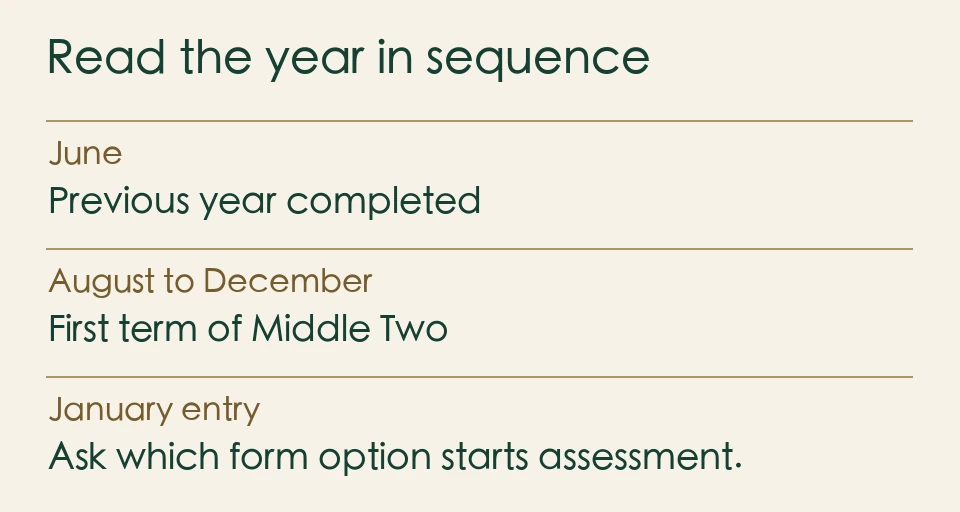
Write down when the current year began, when it will end and which year the student has already completed. A move in January can fall in the middle of one school’s academic year and near the start of another’s.
Read the placement rule for this entry point
Look for the receiving school’s own equivalence chart, age cut-off and guidance on midyear arrivals. Check which division the rule covers. Early-years age guidance alone tells you little about how a secondary transfer will be placed.
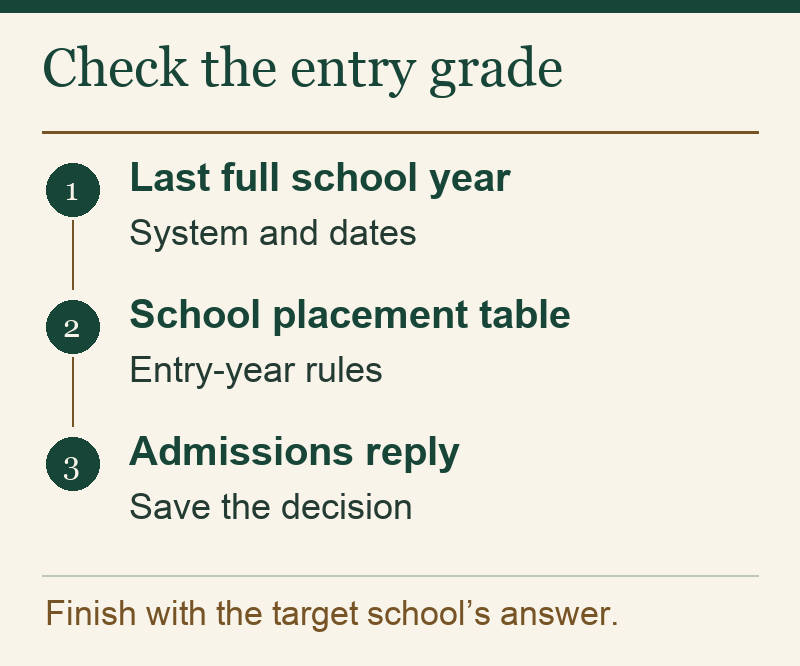
Ask for the form option by name
Send admissions the current year label, term completed and intended start month. Ask which entry year to select and what school record will support that choice. The response is more useful than a generic explanation of national grade systems.
Keep the decision where the form is filled
Record the school’s wording, its date and the entry option together. On a family call, read the actual option aloud alongside the familiar year name, particularly when siblings are entering different divisions.
Establish what the student will have finished on arrival
Ask for the year name printed on the most recent report and read the reporting period below it. A document headed Year 6 might report the first six weeks, the first term or the completed academic year. Copy the period as printed. Add the date the family intends to leave and the date the student would normally finish that year. You now have enough information to explain a midyear departure without describing it as completion. If the most recent report is from a previous school, ask which part of the current year was spent elsewhere.
Build the account in chronological order. “Completed the preceding year in June, began the current year in August, will leave after the December report” is clearer than “currently in the equivalent of sixth grade”. Preserve a local year name in its original language and add a short explanation in the enquiry. If the school uses a stage or a class name that spans two age groups, ask the class teacher or registrar what the report certifies. Leave the receiving school to decide how it reads that sequence.
Ask about the intended starting date once more after writing down the sequence. A family can mean either the first day it is present in the country or the first day the child can attend. A student arriving in May may prefer to finish the present year remotely until June. Those choices produce different placement questions. Make two dated scenarios if the family is considering both. Avoid asking admissions to issue a single definitive answer while leaving out the difference between the scenarios.
Read the school's chart all the way to its heading and notes
Find the version that names the proposed intake year and campus. Read the heading above the age bands, the footnote beneath them and any instructions specific to transfers during the year. Some charts are a general introduction to the school's terminology. Others describe which option a parent should select on an enquiry form. Record which question the chart answers before using it. If the dates apply to an earlier intake, you can use the chart to understand the names, then ask whether the published rule for the coming intake has changed.
When a birthday falls near a boundary, copy the two adjacent ranges with their day, month and year. An ambiguous date such as 04/05 is a poor basis for choosing a year. Spell out the month in your question and use the minimum personal information admissions needs to interpret the rule. If the published ranges leave a gap or appear to overlap, quote the relevant heading and ask the school which range it intends. A one-day difference should come from the school's rule, not from an adviser's choice of date format.
Check that the school division actually offers the proposed intake. A primary admissions office might confirm an age band but direct an older transfer to a separate secondary assessment. A general chart cannot tell you whether the relevant campus has places. Keep an enquiry about the form option separate from an enquiry about availability. Families often hear a year label and assume the child has a place in that year. Tell them exactly what the answer lets them do next.
Describe interrupted schooling without inventing an equivalent
A family may have moved twice, spent a term studying at home or repeated part of a year after a change of language. Ask the family to date each period and identify the available school records. Write “studied from home between February and April; no school-issued report for this interval” when that is what the family tells you. Do not fill the gap by extending the dates of a previous report. Ask admissions what alternative evidence it will consider and whether the decision belongs to admissions or the academic division.
In a mixed-age classroom, the child's class name may say little about subjects completed. Ask for one representative current report and its grading key when needed. If the receiving school asks about a specific subject, identify the subject title, period taught and level the issuing school actually records. Avoid converting marks or setting a level yourself. The transcript review explains how to keep the report period and issuing school visible when gathering supporting evidence.
Send an enquiry that can survive a change of adviser
Use a subject such as “October entry enquiry — North Campus — application year option”. In the message, describe the last complete school year in one sentence and the current partial year in another. Give the proposed starting month and the options the parent actually sees. Then ask: “Which option should the family select to apply for this intake? Is that an administrative selection pending assessment, or does your reply also settle placement? Please tell us which report period you need to check the application.”
A reply of “apply for the age-appropriate year” may still leave two possible form entries. Reply in the existing conversation with the exact labels and a description of the unresolved point. If the school has given a clear form option but says placement will follow assessment, stop asking it for a final decision at this stage. Record who will arrange the assessment, what the family needs to bring and where the instructions will arrive. A calendar entry is useful once there is a confirmed date.
Fictional example: a form choice that changed when the move changed
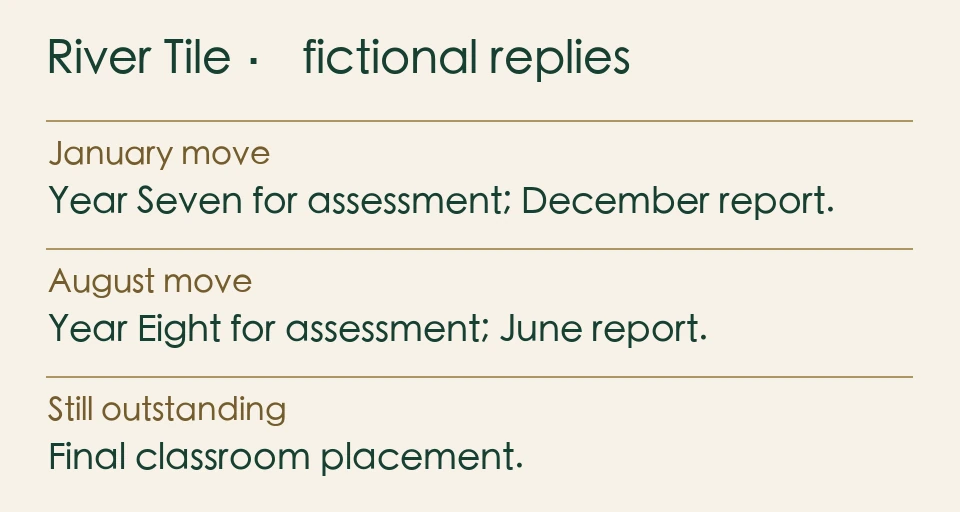
At fictional River Tile School the application asks for Year Seven or Year Eight. A student at fictional Juniper Court expects to leave in December after completing only the first term of the year labelled Middle Two. The family assumes Middle Two should map to Year Eight and starts a draft. Before submission the adviser reads the report, writes down the August start and June finish of Middle Two, and asks River Tile which option applies to a January arrival. The draft remains unsubmitted while the family waits.
River Tile replies that for the January intake this family should select Year Seven for assessment and include the December report. The adviser copies that wording into the application note and reads it to the parent. “We can complete the form for assessment using Year Seven. The school has asked for the first-term report. It will confirm classroom placement after the assessment.” The parent asks whether this means the child must repeat an entire school year. The adviser takes that separate question to the academic contact; the form instruction alone cannot answer it.
A week later the move is postponed until August. The student can now finish Middle Two and obtain the June report. The original reply remains a valid record of the January advice, but it describes a different academic history at the point of entry. The adviser sends the new dates in the same enquiry, identifies the completed year and asks for the August form choice. Admissions replies Year Eight for that intake, subject to its assessment. The family updates the draft intake and year together and checks the summary before submitting.
The closing note reads: “For August at River Tile, choose Year Eight. June completion report requested. Academic placement follows assessment. January advice retained with the earlier enquiry.” This is the result for a fictional child's two dated enquiries. The names Middle Two and Year Eight cannot be carried across to another child as a conversion table.
Check the answer before the family presses submit
Read the campus, intake and form year aloud while the parent looks at the same fields. Compare them with the most recent applicable school response. Check whether a drop-down reset the year after the parent changed campus. When the family has two children, have the parent identify which child's report is attached before moving to the second form. Save the school's instruction with the relevant application and distinguish the submitted form option from any subsequent assessment outcome.
If the family has already submitted the wrong year, retrieve the acknowledgement and contact the school through its stated correction channel. Give the reference, explain the original selection and quote the later instruction. Ask whether admissions can amend the existing application or needs some other action. Wait for that answer before starting another application or paying a second fee. The matter is resolved when the school confirms what it has recorded, and the family can say which part of placement, if any, still depends on assessment.
Before a campus visit, ask which classroom or division the school plans to show the child. An assessment form can use one administrative year while a tour is organised by age group. If the visit programme seems inconsistent with the admissions reply, take both documents to the organiser. A tour of a neighbouring year group need not reopen a form choice the school has already confirmed.