Reconstruct the last school term
Record the name the current school gives the year group, the curriculum and the last term the child expects to finish. A family moving between school calendars may describe the move as “next year” while the two schools mean different intakes.
Find one deal-breaker
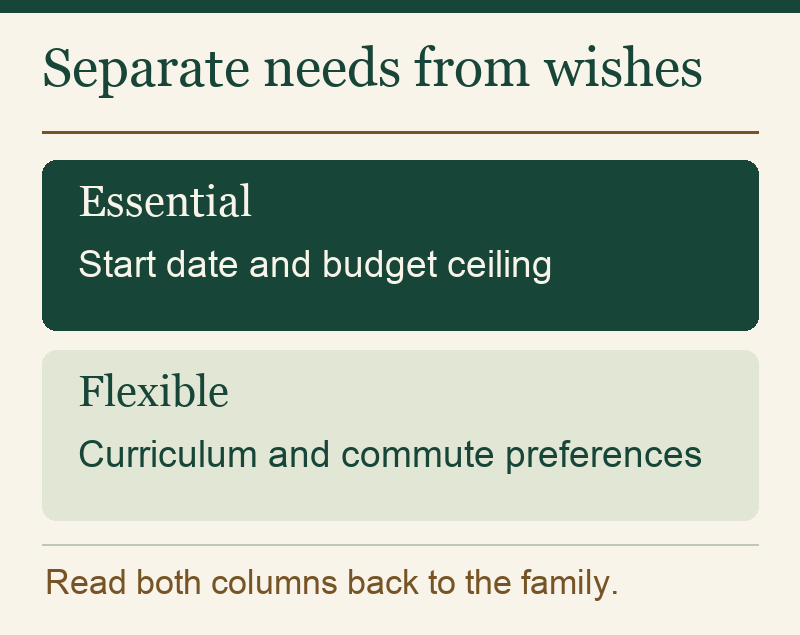
Invite the family to choose between two plausible options. Would they accept a longer commute for an immediate place? Could a sibling attend a different campus? The answer tells you which constraints to apply first when researching schools.
Collect a decision, then the paperwork
Agree what question you need a document to answer. A first conversation about transport and curriculum rarely needs a copy of a passport. If a school later needs one, establish the recipient, the family’s permission and the route for sending it.
Read the brief back
End with a sentence the parent can correct: “You need a midyear place, reachable after work, with continuity in the current language programme.” Add one action for the adviser and one for the family, each with a date to reconnect.
Start the meeting with a question the family could answer today
“What would you like to be able to do after this call?” gives a family room to say they simply need to know whether a January move is possible. A long questionnaire about applications can make that conversation feel much more advanced than it is. Write the answer in the family's own words. If one parent wants a list of schools while the other wants to know whether the children can stay together, read both aims back and agree which question must be answered before the other.
Ask who is present, who needs the summary and who will take decisions later. A relative may be doing the research while the parents are still overseas. Thank them for what they know and mark what the parents need to confirm. Do not quietly turn “I think they could manage that commute” into a family preference. Plan one short follow-up with the decision maker instead of repeating the entire interview when the family arrives.
Use events as anchors for uncertain dates
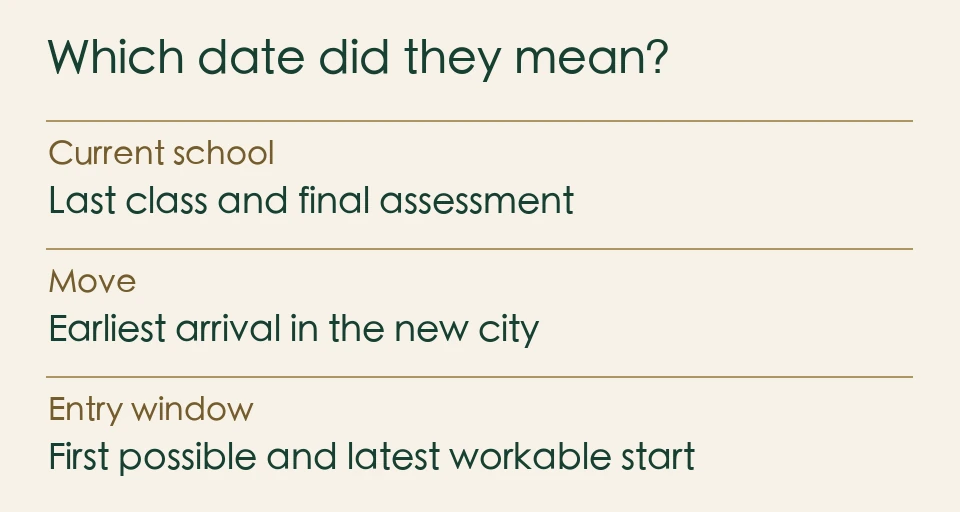
Draw four lines on paper. On the first, put the last day the child expects to attend the current school. On the second, put the family's earliest arrival. The third belongs to the earliest day the child could realistically attend class. The fourth is the latest date the family can manage without a place. These dates can differ substantially. A child can arrive before their parent starts work yet have a final assessment to complete remotely with the previous school. Give each date a source and distinguish a booked journey from a plan.
If the dates are still moving, ask what will settle them. An employer may issue a transfer letter next Wednesday. A landlord may confirm the move after an inspection. Write “parent will update after Wednesday's letter” and agree whether to start a limited search now. A range bounded by events lets you ask a school a useful question about entry in the middle of a term without pretending the family has committed to a particular week.
Record the year group as the child's school writes it. Ask which academic year the report covers and which term they will complete before moving. When the parent gives an approximate equivalent in another system, keep their estimate separate. Take that description into the placement enquiry and ask the receiving campus which year it would assess. A family can then discuss actual entry options instead of applying a guessed conversion to every school.
Find out what an ordinary school day would require
Walk through one Tuesday with the parent. Who leaves home first? Where does the younger sibling go? Who can collect the older child if an after-school activity ends after the last bus? “A school within thirty minutes” may stand for a very specific requirement: a parent has to reach work by eight and cannot drive two children in opposite directions. If there is already a neighbourhood under consideration, use that as the starting point. If housing is undecided, ask which commute should be checked first and revisit the assumption once a home is chosen.
Use a trade-off question sparingly. Offer two realistic possibilities and allow the family to reject both. “If the closer campus can take only one child, would you consider two campuses, wait for places together, or look elsewhere?” The answer reveals whether sibling placement is essential. Ask what evidence would change the choice. The family might consider separate campuses only if both have a bus that reaches the same stop. Turn that condition into a question for transport staff rather than writing that the family is generally flexible.
Discuss costs in terms of a decision. Is the family asking what they must pay before starting, the recurring annual cost, or the part their employer will cover? An employer may cover tuition but require the parent to pay transport directly. You can note “parent will confirm which categories the allowance covers” without asking them to send the entire employment agreement. The fee comparison worksheet becomes relevant when you have a named campus and academic year to check.
Hear the student's account without promising a placement
Give the student a question that invites description. “Which part of a normal school day would you most like to keep?” may elicit an answer about learning science in one language and socialising in another. Note the child's wording and ask the parent which language the current report uses. Avoid labelling a student fluent in the language of instruction on the strength of a short friendly conversation. A school may have its own way of assessing readiness.
Where a family raises a learning or access need, ask what currently helps the child participate and what the family wants the admissions team to answer. For example, a parent may want to know who discusses classroom access before a campus visit. Record that question and agree who may receive the enquiry. It is possible to establish whom to contact before sending any personal report. If a school asks for more detail, return to the family with the recipient, purpose and requested document.
Fictional example: a shortlist that had to wait for a bus answer
The fictional Reedbank family calls about a move in January. The parent initially asks for three schools with places for two siblings. During the call the adviser learns that the parent will be at work before either child starts school and the other adult will be travelling during the first month. Both children must reach school from one pickup point. The older child also wants to finish a performance at the current school in December. Neither fact appears in the original request for a shortlist.
The adviser reads the emerging brief aloud. “We can enquire about January entry for both children. To keep a school on the list we also need the morning pickup arrangement for each child's campus. I will check transport before suggesting visits. Can you send the neighbourhood you are considering and the last school day for each child?” The parent corrects one detail. The younger child could start later if the family can secure an agreed start date. The note now contains two entry windows and one shared transport condition.
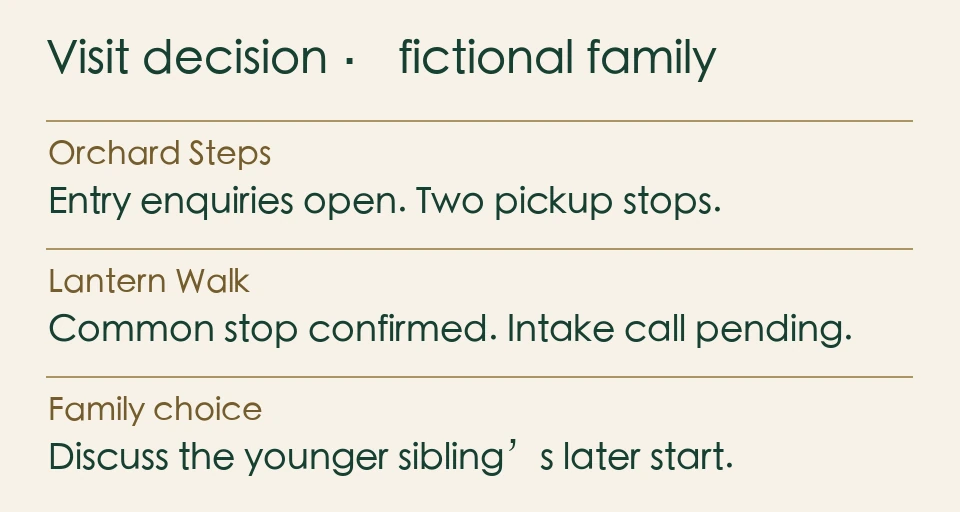
At fictional Orchard Steps School, the admissions office confirms it will consider both year groups but directs bus questions to a separate office. The adviser reports exactly that and requests the transport contact. At fictional Lantern Walk School, the bus office confirms a common stop but admissions has only acknowledged the enquiry. The two schools remain on a working list with different unresolved questions. Neither becomes a confirmed option until admissions and transport evidence apply to the same campuses, year groups and start period.
On the agreed follow-up day Orchard Steps confirms the younger child's bus reaches a different stop. The family takes that option off the visit list for the initial move. Lantern Walk offers a call to discuss the later start for the younger sibling. The adviser books the family conversation after checking availability. The outcome of intake is a specific next conversation about a workable journey and two start dates. Sending a long list on day one would have left all three issues unresolved.
Leave the family with a correction they can make
Close the call with a short message they can amend from their phone. “I heard that the children can start at different times, provided the pickup point works for both. I will ask each campus about the bus and entry year. Please correct the start windows below and tell me when the housing area is confirmed. I will send the first replies on Thursday even if one school is still checking.” Use a definite date after checking your diary and identify one family contact for corrections.
Look for three common omissions before you file the note. A priority may have no named decision maker. A desired programme may have no stated language or entry year. A proposed school may have no evidence for the condition that matters most. Turn each omission into a question addressed to the person who can answer it. When the parent comes back a month later, read the decisions with their dates and ask what has changed since the conversation. Keep the original reason visible when a later answer changes the direction of the search.
If the parents disagree with one another, send each proposed condition back as a question for the family to resolve. For instance, ask whether staying together takes precedence over the older child starting immediately. Until they settle it, research options under both assumptions and avoid booking a visit whose value depends on an unmade family decision.